
When I travel, I’m always on the lookout for interesting places to paint. It’s simply part of who I am as an artist. I’m drawn to locations that offer something visually unique—places that invite me to slow down and really observe.
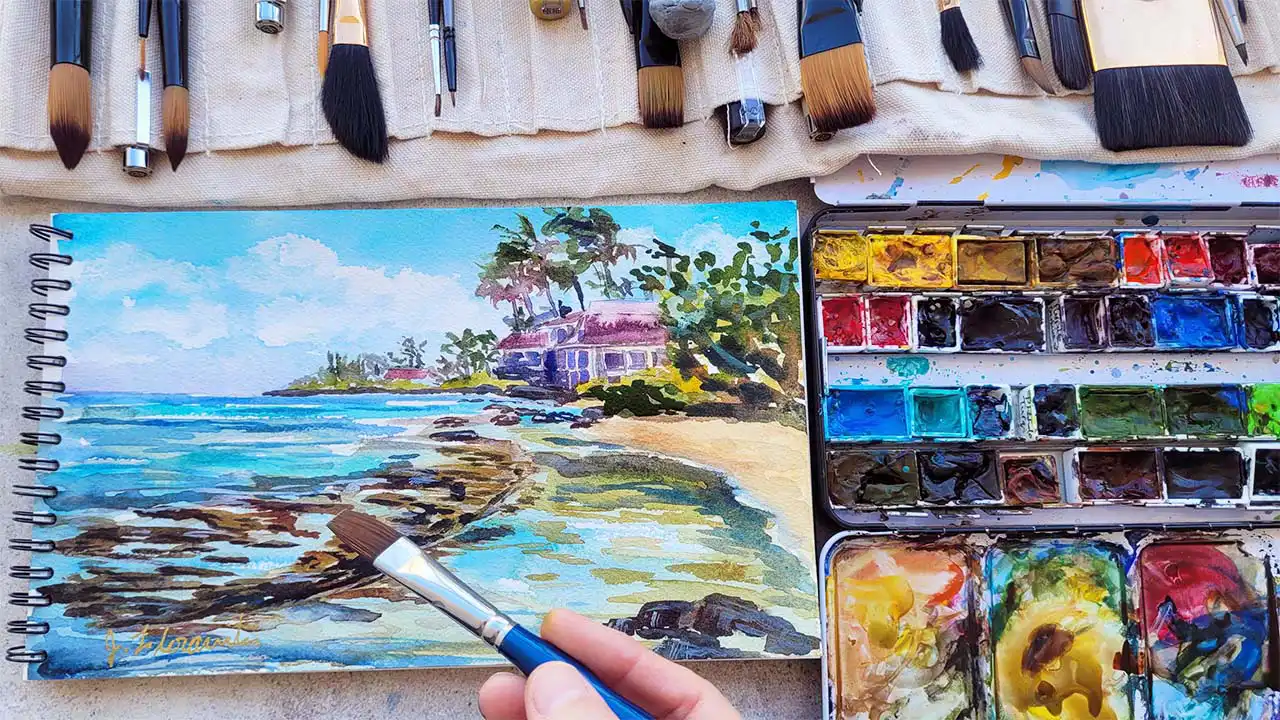
What immediately captured my attention here (at Honokōwai Beach) is the unusual shallow rock formation that runs parallel to the shoreline. The ocean washes up and over these rocks, creating calm, shallow pools both within the reef and along the beach itself. These pools reflect the sky beautifully and hold subtle, serene color shifts.
Beyond the rocks, the ocean transitions from light turquoise into soft lavender tones, then deeper cobalt and ultramarine blues. That gradual color movement is endlessly inspiring to me.
I also love incorporating architecture into my seascapes whenever possible. This beach offers views of beachfront condos built in the 1960s, and they bring a subtle mid-century nostalgia that contrasts nicely with the organic shapes of the reef and water.
All of these elements together are what made me choose this scene.
Five Tips to Improve Your Watercolor Practice
In this video, I’ll share five important ideas that can help strengthen your watercolor practice when painting beaches and water—especially when working in a sketchbook. These tips are not necessarily in order of what you are seeing as I condensed and edited the progress of this 1 hour watercolor into just over 12 minutes for you to watch.
1. Identify and Create Your Atmosphere
The very first thing I focus on is atmosphere.
I begin by painting the background clouds seen in the first few seconds of this video, aiming to create the feeling of a warm, balmy tropical day with light trade winds moving through the sky. This is one of my favorite times of day in the Hawaiian Islands—the atmosphere is bright, calm, and expansive.
An interesting side note: some of my quickest-selling island paintings over the years have been sunset scenes. I think sunsets represent ultimate relaxation for many people. But personally, I’m endlessly inspired by pure daytime in Hawaii. It doesn’t matter which island.
This painting isn’t for a client—it’s simply for my own practice and enjoyment. That freedom allows me to explore the atmosphere without expectation.
2. Identify Architecture in Natural Elements
Once the atmosphere is established, I begin sketching in the shallow rocky reef.
I like to think of this as nature’s architecture. The reef has a flat, structured quality and I use a flat brush with horizontal strokes to capture both its shape and texture. The way the water flows in and gathers into small pools is something I want to suggest.
Sketching and painting rocks directly from life is one of the best ways to build confidence with structure and form.
This scene also includes those 1960s-era beachfront condos that bring a certain nostalgia. Perspective is important here, but I don’t want them to overpower the natural elements. I’ll refine these buildings later in the painting.
3. Work Light to Dark When Painting Water & Reflections
As I move into the water, I start laying down light washes of color and allow them to blend naturally.
Water is rarely just blue in tint.
Even in the brightest areas, you might find hints of violet, green, or warm neutral tones. Sometimes only a small percentage of a color shift can make water feel more believable.
I always work light to dark, especially in watercolor. Some areas of water are incredibly pale right next to very dark passages. Starting light gives you room to layer and adjust as the painting develops.
4. Simplify Whenever Possible
Simplification is especially important when painting on location—or when working small in a sketchbook.
Less really can be more here.
And honestly, this is something I still struggle with. I tend to want to include too much, especially in small paintings. My larger studio works can handle more detail, but a sketchbook painting benefits from restraint.
Reflections & Motivation
One of my favorite parts of this entire process is painting reflections in the water. It’s the part I look forward to the most.
Painting, for me, is truly about the process. I used to think it was all about the finished result—but what actually motivates me is the act of creating: moving the brush, mixing color, responding to what’s happening on the paper.
Understanding what motivates you creatively is a huge part of building consistency in your art practice.
5. Be Bold — Take Risks
Growth in painting comes from observation and risk-taking.
Don’t be afraid to make marks.
Don’t be afraid of bold color.
And don’t shy away from colors that feel unexpected.
Often, those risky moments become the most interesting parts of a painting.
A Lifetime of Painting
Painting is something I’ve been fortunate enough to make a living at. I’ve been able to do what I love on a daily basis for many years, and that’s a true gift.
Few people can say they still love what they do decades into it. Painting has been a steady force in my life—something that challenges me, grounds me, and continually lifts me up.
Reef Perspective & Brushwork
The rocky reef here is another example of nature’s architecture.
To make it convincing, I keep many of my brushstrokes parallel. This reinforces perspective and helps ground the reflections in the water. You can achieve this with either a flat or a round brush.
Even though this is a small painting, it contains fairly advanced techniques. Keeping your arm moving—not just your wrist—helps create natural motion in water.
Painting Dark Rocks & Foliage
For the darker rocks, I mix my browns and blacks using multiple pigments rather than relying on black straight from the tube. This creates deeper, more interesting darks.
Watercolor also dries lighter, so saturation matters. As the paper becomes more saturated, pigments sit closer to the surface, often resulting in stronger contrast and purer color.
When painting background foliage—trees, palms, and dense greenery—I keep things suggested rather than detailed. My brushstrokes are loose, random, and expressive. Over many years, I’ve developed a kind of visual language for tropical foliage.
CTA: If you’d like to see a dedicated video on painting lush background foliage or palm trees, let me know in the comments.
And if your marks start to feel repetitive, switch brushes. I do this often when painting backgrounds.
Closing Thoughts
Over a lifetime of creating, I think every artist eventually finds the subjects—or mediums—that truly light them up.
I’ve explored many art forms through the years, but I always return to watercolor, even if only in a small way.
This painting took about one hour to complete.
Many of my other watercolor sketchbook videos are more tutorial-focused, so feel free to explore those if you’d like to paint along.
If you found value in this travel sketchbook watercolor video, please like and subscribe—it truly helps support the channel.